60-70% of B2B blog content generates no pipeline. I built a Content ROI Auditor that scores any article across 6 commercial dimensions and tells you whether it has a path to revenue or is vanity content burning budget. I ran it on my own blog first. One of my most data-heavy posts failed. Here's the framework, the real audit, and the free skill you can download to run it yourself.
TL;DR: 60-70% of B2B blog content generates no pipeline. I built a Content ROI Auditor that scores any article across 6 commercial dimensions and tells you whether it has a path to revenue or is vanity content burning budget. I ran it on my own blog first. One of my most data-heavy posts failed. Here's the framework, the real audit, and the free skill you can download to run it yourself.
You've got the blog.
50 posts. Maybe 100. Published on schedule, promoted on social, reported on in the monthly deck.
And yet when someone asks "which of these drove a lead?", the room goes quiet.
The problem is not that you haven't published enough content. The problem is that most of it was never built to generate pipeline in the first place.
60-70% of B2B blog content drives zero pipeline (Demand Gen Report / SiriusDecisions). Not low pipeline. Zero. These are articles that exist, get indexed, occasionally get traffic, and produce absolutely nothing commercial. They're a cost line dressed up as a marketing activity.
I built a framework to catch this before publishing, not after. It's called the Content ROI Auditor, and it scores any blog post or article across 6 commercial dimensions to give you a clear verdict: does this content have a path to pipeline, or is it vanity?
I'll walk through exactly how it works, show you what happened when I ran it on my own blog, and give you the skill for free at the end.
The 6 Dimensions of content auditing
The auditor scores content across 6 dimensions. Each one gets a rating: Strong, Needs Work, or Missing, backed by evidence quoted directly from the text.
Pipeline alignment - Does this content map to a buyer journey stage (TOFU/MOFU/BOFU) and move the reader toward a commercial action?
Commercial intent - Does the content reference problems the business solves and position the brand as the answer?
CTA strength - Is there a clear, specific, stage-appropriate next step?
Specificity - Concrete data, named examples, and actionable frameworks, or generic filler?
Search intent match - Would someone searching for this topic be a potential buyer?
Content type effectiveness - Is this content format proven to drive pipeline?
The overall verdict follows a rule, not a feeling:
0-1 dimensions Missing, no more than 2 Needs Work → Commercial path
2-3 Missing or 3+ Needs Work → At risk
4+ Missing → Vanity content
How the Audit Works
The auditor runs in two phases.
Phase 1: Score with evidence
For each of the 6 dimensions, the auditor examines the content and scores it against a defined rubric. Every score has to be backed by quoted text from the article. If there's no evidence in the content, the score is "Missing" - you can't infer intent that isn't on the page.
Three checks stand out:
The interchangeability test.
Could you swap your brand name with a competitor's and the article would still make sense? If yes, the content is generic. It doesn't matter how well-written it is. If a competitor could publish it, it's not doing the commercial work you need it to do. The auditor runs this test against your named competitors specifically.
The CTA stage match.
A BOFU call-to-action ("Book a strategy call") on a TOFU article ("What is content marketing?") is a mismatch. The reader has just learned about a concept. They're not ready to buy. The auditor checks whether the CTA matches the funnel stage of the content. Pages with stage-matched, specific CTAs convert 2-3x compared to generic "contact us" buttons (HubSpot).
The filler count.
The auditor counts actual filler sentences - sentences that add no new information. Not an estimate. A count. High filler-to-substance ratios are one of the clearest signals that content was produced to hit a word count rather than to move a reader.
Phase 2: Prioritised rewrites
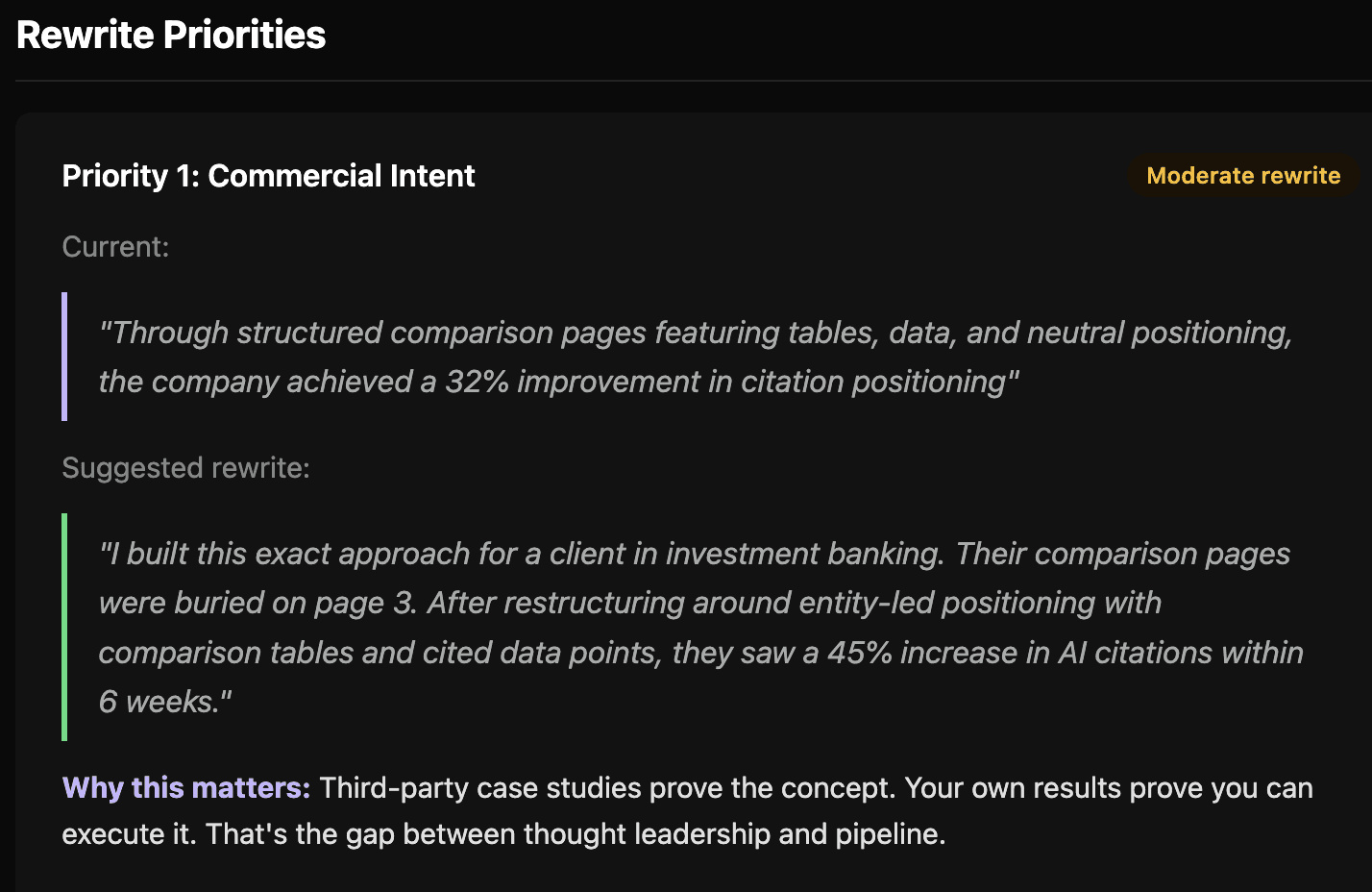
After the scorecard, the auditor ranks every "Needs Work" and "Missing" dimension by impact on pipeline and provides specific before/after rewrites.
Priority order: Commercial intent > CTA strength > Pipeline alignment > Specificity > Search intent > Content type.
Each rewrite quotes the original text and provides a replacement with an explanation of why the change improves commercial ROI. "Add more specificity" is not a rewrite. "Replace this paragraph with these three data points from your client work" is.
What You Need to Run It
The auditor runs inside Claude Code as a slash command. No paid tools. No integrations. No setup beyond dropping a file in a folder.
Claude Code - Anthropic's CLI tool or VS Code extension - Free tier available
The skill file - One .md file dropped into your .claude/commands/ folder - Free (link below)
Once installed, you run /content-roi-auditor and paste in your article. The auditor will ask you for four things before it starts:
Your ICP - who is the ideal customer (job title, company size, challenges)
Your value proposition - what you sell and the core problem you solve
Your competitors - 2-5 direct competitors (used for the interchangeability test)
The content - the article text itself
It won't start without all four. An audit without knowing who the content is for and what the business sells is meaningless.
I Ran It on My Own Blog. Here's What Happened.
I tested the auditor on one of my own articles: The 23x Conversion Advantage: Why AI-Recommended Traffic Outperforms Traditional Organic (https://www.jmredman.com/blog/ai-models-conversion-advantage).
This is a post packed with data. 20+ statistics with sources. Real company examples (HubSpot, Radix, G2). Actionable frameworks for GEO optimisation. I was confident it would pass.
It scored "At risk."
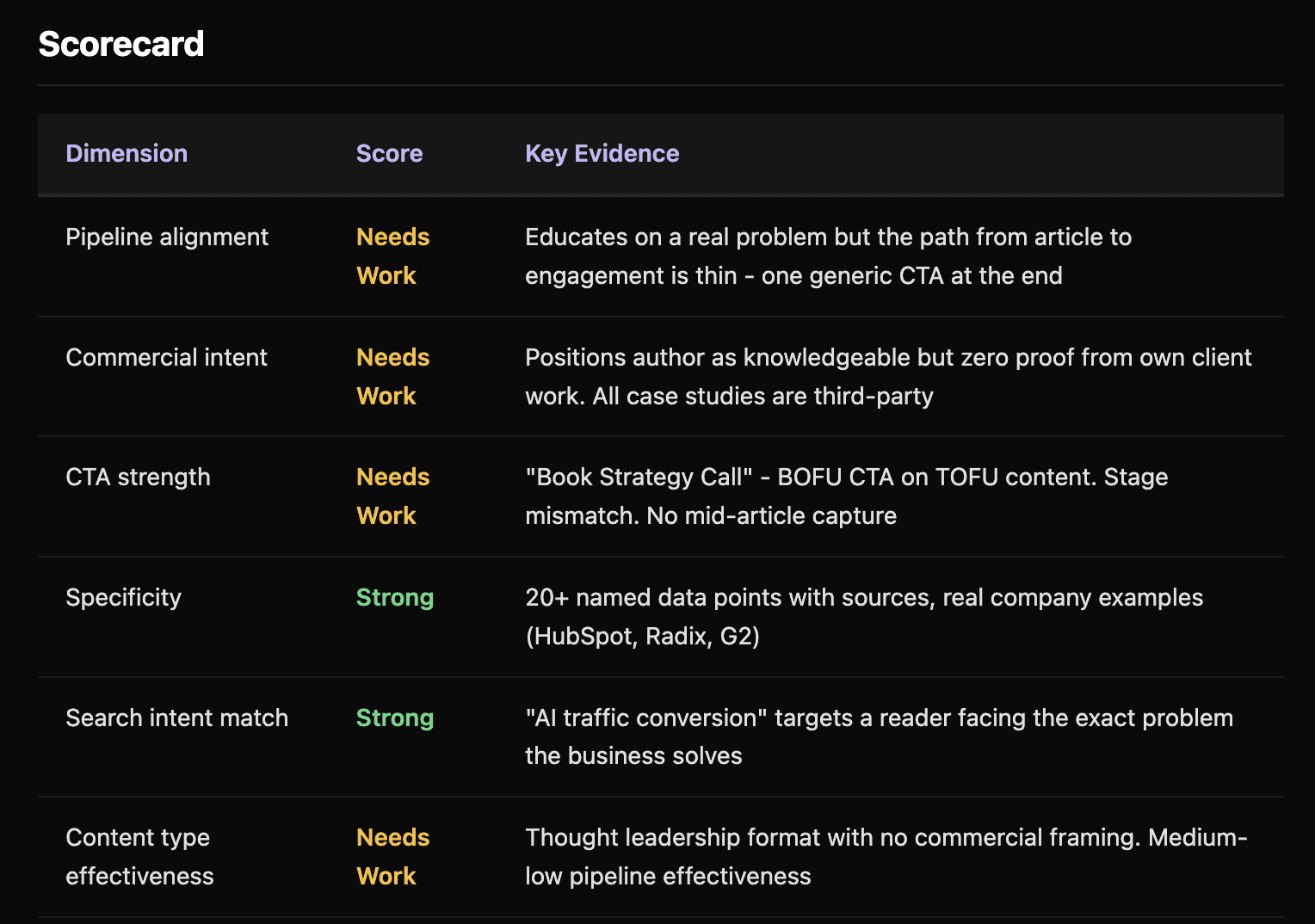
Here's the scorecard:
Pipeline alignment - Needs Work - Educates on a real problem but the path from article to engagement is thin - one generic CTA at the end with no mid-funnel bridge
Commercial intent - Needs Work - Positions me as knowledgeable but doesn't connect the problem to my offering. Zero proof from my own client work. All case studies are third-party
CTA strength - Needs Work - "Book Strategy Call" at the end. BOFU CTA on TOFU/MOFU content. Mismatch. Generic. No mid-article capture
Specificity - Strong - 20+ named data points with sources, real company examples, actionable frameworks
Search intent match - Strong - "AI traffic conversion" targets a reader facing the exact problem I solve
Content type effectiveness - Needs Work - Thought leadership format with no commercial framing. Medium-low pipeline effectiveness
The specificity was strong. The search intent was right. But three things killed the commercial potential:
Every proof point was someone else's. HubSpot's traffic decline. Radix's citation improvement. G2's markdown testing. I proved the concept works in theory but didn't prove I can execute it. The interchangeability test flagged this - a competitor could have published the same article using the same public research.
The CTA was a stage mismatch. "Book a Strategy Call" is a BOFU ask on a TOFU article. A reader who has just learned about GEO is not ready to buy. They need a mid-funnel offer first - something like a free content audit tool they can run themselves.
No bridge between education and services. The article taught the reader everything they needed to know and then let them leave. The "Building Systems That Compound" section was the perfect place to say "this is where most teams stall, and this is what I build" - but it didn't.
The fixes are specific. Add 1-2 proof points from my own client work. Replace the CTA with a stage-matched mid-funnel offer. Add a bridge paragraph connecting the education to my services. Three changes to move it from "At risk" to "Commercial path."
When to Run This
Three moments where the auditor earns its keep:
Before publishing any new blog post. Run the audit on the final draft. If it scores "At risk" or "Vanity", fix it before it goes live. Publishing content that fails the commercial test is publishing cost, not marketing.
When auditing your existing content library. Pick your 10 most-trafficked posts. Run each one through the auditor. You'll likely find that your highest-traffic content is also your lowest-converting - because it was built for search volume, not pipeline alignment.
When briefing writers or agencies. Share the 6 dimensions and scoring rubrics before the first draft. If the writer knows what "Strong" looks like for commercial intent and CTA strength, the first draft comes back closer to publishable. Stop editing content into commercial shape after the fact. Build it in from the start.
Get the Skill
The Content ROI Auditor is free. Download the .md file, drop it into your .claude/commands/ folder, and run /content-roi-auditor in Claude Code.
Get the SKILL
Get the SKILL
The full skill includes scoring rubrics for all 6 dimensions, output templates, two worked examples (a failing audit and a passing audit), and anti-hallucination guardrails so the scores are evidence-based, not generated fluff.
If you want a GEO skill that optimises content for AI model citations (ChatGPT, Claude, Perplexity, Google AI Overviews), that's in the same repo: Organic Growth Skills on GitHub → https://github.com/Didgeheads/organic-growth-skills
If You Need More Than a Skill
The auditor tells you what's broken. Fixing it at scale - building the content systems, editorial workflows, and pipeline attribution that turn organic into a compounding asset - is a different problem.
That's what I do. I embed directly with marketing teams to build organic growth engines that reduce paid dependency and drive measurable pipeline. First deliverables in 7 days.
If your content library is full of articles that look busy but generate nothing, and you want someone who's built the fix across insurance, investment banking, fintech, SaaS, eCommerce, and wellness - book a 15-minute pipeline review.
Get in touch
Get in touch
Created by Jessica Redman, Didgeheads (didgeheads.com). Based on research from Demand Gen Report, SiriusDecisions, HubSpot, G2/Radix, Aberdeen Group, AirOps (2026 State of AI Search).

Jessica Redman
GEO, SEO and AI enablement consultant. Ten years across insurance, SaaS, eCommerce and regulated B2B.
Keep reading