A full breakdown of the seven-part GEO strategy behind 125% organic visibility growth.

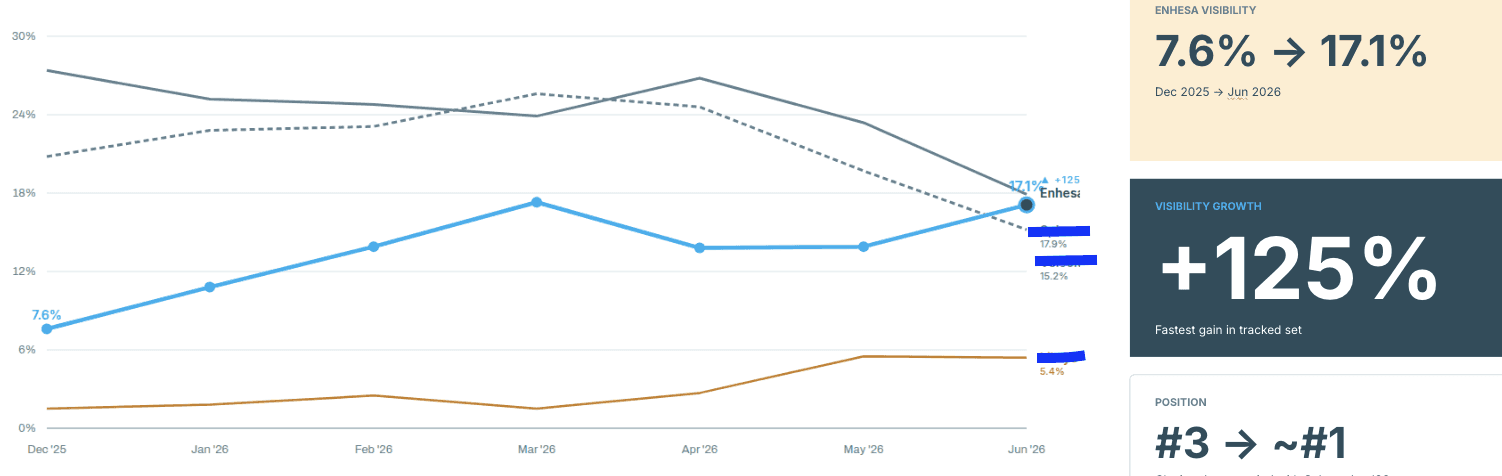
+125%
organic visibility
631 / 845
tracked keywords in AI Overviews
2
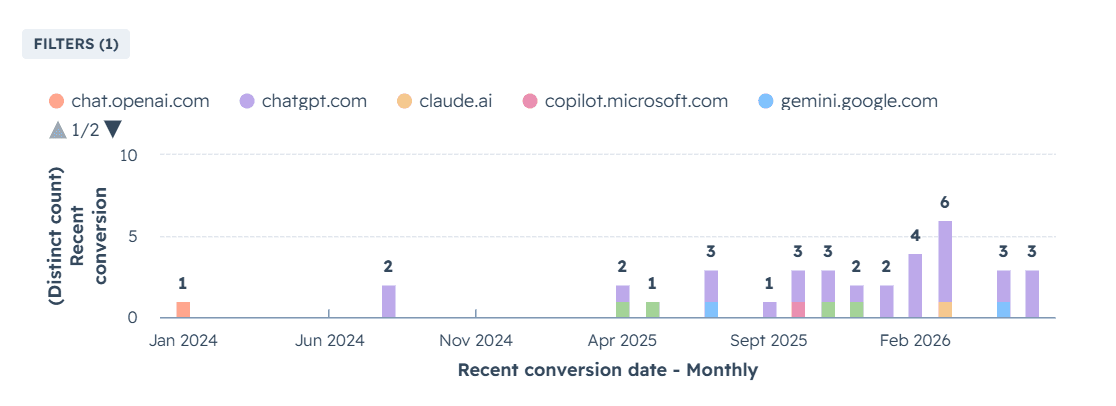
enterprise deals sourced from ChatGPT
Enhesa sells regulatory compliance software to Nike, Shell, Pfizer, Unilever, New Balance. Half the Fortune 500 are already clients. Their entire addressable market is a few thousand companies, which means every conversion is a deal worth hundreds of thousands.
Their buyers aren't clicking on ads. They're asking ChatGPT "what's the best EHS compliance software for a company operating across 40 jurisdictions?" and cross-referencing what comes back. The brief wasn't "get more traffic." It was "build the kind of trust that makes AI models recommend you when enterprise buyers are making $500k decisions."
Six months in:
SEO share of voice: 7.6% to 17.1% (+125%) - now tied for #1 in the category
631 of 845 tracked keywords appearing in Google AI Overviews (75%)
47% of all sessions via Direct, driven by AI-search branded demand
Two enterprise deals traced directly back to ChatGPT
Here's what I did.
1. Technical infrastructure for AI crawlability
The first thing we tackled was making sure AI models could actually read the site.
Most people think about technical SEO in terms of Googlebot. LLMs have different consumption patterns. They favour structured, clean content they can parse and synthesise quickly.
We implemented Markdown (.md) versions of every URL. Google does index Markdown files, and LLMs consume Markdown more efficiently than HTML-heavy pages. This is still an underused tactic and one of the first things I now implement for any client.
We ran a full crawl depth audit. The site had accumulated hundreds of pages over the years - overlapping content, pages targeting similar keywords, thin pages that had been indexed but were cannibalising each other. We pruned aggressively. This reduced crawl depth across the site, which meant Google and AI crawlers could reach important content faster and more frequently.
We also rebuilt the URL structure into clear, logical subfolders. Previously URLs were flat and inconsistent. Restructuring into logical hierarchies signals topical authority to crawlers and reduces crawl depth at the same time.
Finally, we ungated a substantial amount of content that had been living inside PDFs. PDFs are largely unreadable by LLMs. If your best thought leadership is locked in a download-gated PDF, it does not exist to ChatGPT. We converted this content to web pages and watched it start appearing in AI answers within weeks.
2. On-site content architecture
The single highest-impact on-page change was adding TL;DR summaries to the top of every blog post.
This sounds simple. It is simple. Research from Princeton, Georgia Tech, and the Allen Institute (KDD 2024) found that structural changes like placing key answers at the top of content significantly boost the likelihood of AI citation. LLMs pull answers quickly. If your most citable information is buried in paragraph six, you lose.
Every article now opens with a 3-5 sentence summary answering the core question directly. Writers brief to this format.
The second structural piece was building a library of competitor comparison pages. Structured to answer the exact questions enterprise buyers ask when evaluating options: "Enhesa vs VelocityEHS", "Enhesa vs Sphera", "Enhesa vs Libryo." Each page links to the others. We're now building a hub comparison page linking out to all of them, which creates a proper topic cluster AI models can navigate and understand.
Comparison pages with three or more structured tables see a 25.7% uplift in AI citations per the same research. We specced every page to hit that bar.
3. Source citation as a trust signal
The KDD 2024 paper from Princeton, Georgia Tech, and the Allen Institute found that adding credible source citations to content boosts AI visibility by up to 30%. Adding statistics lifts it by up to 40%.
We audited every piece of content for citation quality. Unattributed claims got sourced. Relevant studies got linked. Data quoted without a primary source got traced back to its origin and cited directly.
This sounds like basic editorial practice. Most content teams don't do it consistently. In an AI-search world it's a material ranking factor.
4. Content freshness at scale
76.4% of ChatGPT's most-cited content was updated within the last 30 days. Content untouched for six months is three times more likely to lose AI citations than recently refreshed content. Freshness is a citation signal, and traditional SEO tools don't track it.
We couldn't manually refresh hundreds of pages. So we built a system.
Enhesa's product marketing team already maintained a set of Confluence documents covering product positioning, competitive intelligence, regulatory updates, and company messaging. We built a Claude-powered content refresher skill that connects directly to these files. When the product marketing team updates their documents - which they do in real time as regulations change - the skill flags articles that need refreshing or generates updated drafts for editorial review.
The content strategy is always grounded in the most current product and regulatory information. In a compliance category where the landscape shifts constantly, that's not a nice-to-have.
5. Harmonising your online reputation
LLMs don't only read your website. They synthesise information about your company from everywhere it appears: press releases, directory listings, third-party reviews, old blog posts, partner pages, industry publications. If those sources are citing out-of-date positioning, old product names, or stale statistics, your online profile is inconsistent - and AI models reflect that inconsistency back to buyers.
We audited third-party sources referencing Enhesa and updated or requested corrections wherever information was stale. Unglamorous work, but it builds the consistency AI models need to represent your brand accurately.
Your company has one version of the truth. Every external reference should reflect it.
6. Third-party review platforms
85% of AI brand mentions come from third-party sources, not your own website. If you're only optimising pages you control, you're missing most of the signal.
We focused on G2 and Capterra specifically. Both platforms have strong domain authority and LLMs frequently cite them when answering "what's the best [category] software" queries. We built a structured programme to incentivise account managers to request reviews from clients at the right moment in the relationship. Volume of recent, credible reviews is a direct input into how confidently AI models recommend you.
7. Mid-funnel content
This was the biggest strategic gap we found, and in my experience it's consistent across almost every B2B company I work with.
Traditional SEO strategies concentrate on top-of-funnel awareness content because that's where search volume lives. The problem is that awareness content doesn't answer the questions buyers are asking when they're actually evaluating you. It's optimised for discovery, not for decision.
We used Gong Engage to pull transcripts and themes from client sales conversations, and combined that with internal customer service data, to build a picture of what buyers were actually asking mid-funnel. Questions like: "How does Enhesa handle multi-jurisdiction regulatory changes?", "What does implementation look like for a company with 50,000 employees in 30 countries?", "How does the data get updated when regulations change?"
None of these questions surface in a standard keyword research exercise. All of them were being asked directly to ChatGPT by enterprise buyers doing pre-purchase research.
We built a content programme specifically to answer them - detailed, cited, structured responses that gave AI models exactly what they needed to recommend Enhesa when a Fortune 500 compliance director was doing due diligence.
What this tells us about where GEO is heading
The thing that stuck with me most about this project is how much of it was invisible in traditional reporting.
SEO dashboards show rankings, traffic, and conversions. None of those metrics captured the two enterprise deals that came in through ChatGPT. Both buyers said they'd been using AI tools to shortlist vendors. Enhesa came up consistently. They arrived at the website already half-convinced.
That's a different kind of pipeline than anything traditional SEO was ever set up to measure.
If you're selling to a targeted, high-value audience and organic isn't generating the pipeline it should, the question worth asking isn't "why aren't we ranking?" It's "why aren't AI models recommending us?" Those are different problems with different solutions.
More work