I'll show you the file structure, the rollout, and why none of the high-leverage AI workflows (like a Content ROI audit) actually work until you have one.
TL;DR: Most marketing teams have their ICP in a Notion doc, their value prop in a deck, their tone of voice in a Google Doc, and their messaging matrix in someone's head. The result is content drift - every piece sounds slightly different because every writer (and every AI tool) is working from a slightly different brief. A "marketing shared brain" fixes this by packaging the foundational truth of your brand into a versioned set of markdown files that humans, Claude, and every AI tool in your stack read from. I'll show you the file structure, the rollout, and why none of the high-leverage AI workflows (like a Content ROI audit) actually work until you have one. At the bottom, two of the foundational skills I use are free to download.
The problem: every team has a brain, no team has a shared one
Walk into any marketing team and ask four people to define the ICP. You'll get four answers. Ask them to write the value prop in one sentence and you'll get four versions. Ask them where the messaging matrix lives and you'll get four locations.
This isn't sloppiness. It's the natural state of a function whose foundational documents live in:
- A founder's head
- A sales deck from 18 months ago
- A brand workshop output from the last agency
- A "messaging v3 FINAL FINAL.docx" in someone's Drive
When the team was four people sitting next to each other, this worked. The brain was shared by osmosis.
It does not work now. Now the team has freelancers, an SEO agency, a PR agency, a video editor, a designer, a demand-gen contractor, and a stack of AI tools (Claude, ChatGPT, Jasper, Writer, Copy.ai, custom GPTs) all generating content from whatever brief the human in front of them happened to paste in.
Every one of those touchpoints is a place where the brand drifts. Multiply by the volume of content a modern marketing team ships and you get the thing every CMO complains about: "It all sounds slightly off-brand and I can't put my finger on why."
The reason is that there is no single source of truth. Or there are seven sources of truth, which is the same thing.
A marketing shared brain solves this.
What a marketing shared brain actually is
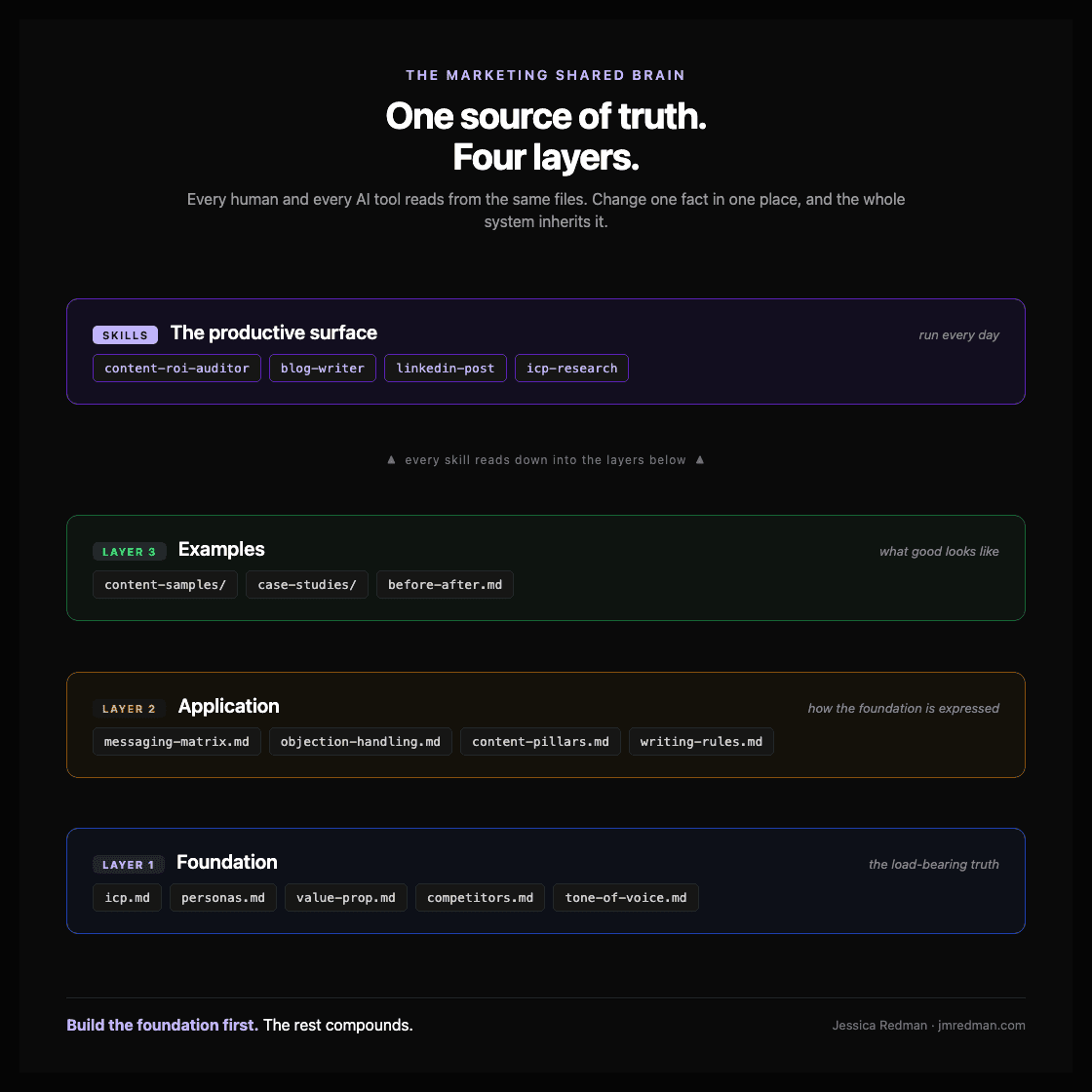
A shared brain is a versioned, structured set of markdown files that contain the foundational truth of your brand:
- Who you sell to (ICP, personas)
- Why they buy (value props, jobs-to-be-done, objections)
- How you talk (tone of voice, writing rules, banned phrases)
- What you sell (product lines, pricing logic, positioning)
- What you compete against (competitors, differentiators, win/loss themes)
- What good looks like (content samples, approved examples)
It lives in a Git repository (so it's versioned, reviewable, and diffable). It's loaded into your AI tools as project context (so every prompt is grounded in it). And it's the brief every human writer works from too.
The point isn't the markdown. The point is that there is exactly one canonical version of every foundational fact about your brand, and everything else reads from it.
When the ICP changes, you change one file. Every piece of content created after that change automatically inherits the new ICP, because every tool and every writer is reading the same file.
Why ICP, persona, and value prop docs belong at the centre
Of all the foundational files, three matter more than the rest: ICP, persona, and value prop.
These three control whether your content is going to the right people, addressing the right pains, in the right language. Get them wrong and the rest of your stack is producing high-volume mediocrity at scale.
ICP answers 'who is this for?' Not "B2B SaaS companies" - that's a market sizing slide. A real ICP is specific enough that a list-builder can pull a target list in 10 minutes and the win rate on that list beats the average. Firmographics, disqualification criteria, intent signals.
Personas answer 'who inside that account am I writing for?' The champion (usually the senior IC who'll evangelise the product) and the economic buyer (usually two levels up, signs the cheque, has different pains). They read different things, care about different outcomes, respond to different proof.
Value prop answers 'why should they care?*'The crisp, one-sentence articulation of the outcome you deliver and who you deliver it to - backed by the supporting differentiators that make it credible.
When these three are in the shared brain, every piece of content has a built-in answer to the three questions that determine whether it converts:
- Is this person in our ICP?
- Am I writing to the champion or the buyer?
- Does this map to a value prop we can actually deliver?
When they're not in the shared brain, every writer is guessing and AI is guessing harder, because it has nothing to ground itself in.
How I build it: the foundational files, layered
I build a shared brain in three layers. Each layer depends on the one below.
Layer 1: Foundation (the immovable truth)
These are the files that change rarely - once a quarter at most. They are the bedrock everything else inherits from.
| File | What it contains |
|---|---|
icp.md | TAM, 2–4 firmographic segments, disqualification criteria, intent signals |
personas.md | Champion + economic buyer for each segment — pains, goals, where they hang out, what they read |
value-prop.md | One-sentence positioning, supporting differentiators, proof points |
competitors.md | Direct + adjacent competitors, where they win, where they lose, our wedge |
tone-of-voice.md | How we sound — voice attributes, banned phrases, sentence-level examples |
Layer 2: Application (how the foundation gets expressed)
These files take the foundation and translate it into the operational artifacts a marketing team uses every day.
| File | What it contains |
|---|---|
messaging-matrix.md | Per-persona × per-stage messaging — awareness, consideration, decision |
objection-handling.md | The 8–12 objections we hear, with the rebuttals that work |
content-pillars.md | The 3–5 themes we own, mapped to ICP pains and value props |
writing-rules.md | Structural rules — headline patterns, paragraph length, CTA logic |
style-guide.md | Capitalisation, punctuation, formatting conventions |
Layer 3: Examples (what good actually looks like)
The thing AI tools (and new hires) need most: ground-truth examples of work that's already on-brand. Without these, you're describing the brand abstractly. With them, you're showing it.
| File | What it contains | |
|---|---|---|
content-samples/ | 5–10 pieces of approved content per channel (blog, LinkedIn, email, sales deck) | |
case-studies/ | Customer stories in our preferred structure | |
before-after.md | Common writing mistakes and how we'd fix them | |
| The reason this layering matters: when you (or an AI) generates a new piece of content, the brief automatically pulls Layer 1 → Layer 2 → Layer 3. The output is grounded in the foundation, expressed through the application files, and stylistically calibrated against the examples. | ||
| Here's the structure I use. It's deliberately flat - deep nesting makes files harder to find and harder to load into AI context windows. | ||
| marketing-shared-brain/ | ||
| ├── README.md ← How to use this repo | ||
| ├── CHANGELOG.md ← What changed and when | ||
| │ | ||
| ├── 01-foundation/ | ||
| │ ├── icp.md | ||
| │ ├── personas.md | ||
| │ ├── value-prop.md | ||
| │ ├── competitors.md | ||
| │ └── tone-of-voice.md | ||
| │ | ||
| ├── 02-application/ | ||
| │ ├── messaging-matrix.md | ||
| │ ├── objection-handling.md | ||
| │ ├── content-pillars.md | ||
| │ ├── writing-rules.md | ||
| │ └── style-guide.md | ||
| │ | ||
| ├── 03-examples/ | ||
| │ ├── content-samples/ | ||
| │ │ ├── blog/ | ||
| │ │ ├── linkedin/ | ||
| │ │ ├── email/ | ||
| │ │ └── sales-deck/ | ||
| │ ├── case-studies/ | ||
| │ └── before-after.md | ||
| │ | ||
| ├── 04-skills/ ← Reusable Claude Code skills | ||
| │ ├── icp-research.md | ||
| │ ├── competitor-research.md | ||
| │ ├── blog-writer.md | ||
| │ └── linkedin-post.md | ||
| │ | ||
| └── 05-campaigns/ ← Active campaign briefs | ||
| ├── 2026-q2-launch/ | ||
| └── 2026-q3-event/ | ||
| A few things that aren't obvious until you've run this for a while: | ||
| The architecture I use moves through three phases and the right phase to start at depends on how technical the marketing team is and what enterprise tooling they already have. | ||
| The first version of the shared brain lives as a Claude Enterprise Project. A Project is the simplest possible shared brain: a single workspace where every team member can chat with Claude and every chat is grounded in the same set of project files. | ||
| The foundational files go into the project as markdown: | ||
| Every team member who uses the project is now writing against the same brain. A blog drafted by the content lead and a LinkedIn post drafted by the demand-gen manager are grounded in the same ICP, written to the same persona, and use the same tone. without anyone having to memorise the brief. | ||
| Phase 1 takes about two weeks. Most of that time is writing the foundational files, not configuring Claude. The technology is the easy bit. | ||
| A Claude Project is a great starting point, but it has limits: no version control, no diffing, no PR review. When the ICP changes, you need to know what changed, who approved it, and when. Because every piece of content created before that change is now operating on a stale brief. | ||
| So the source of truth moves to GitHub Enterprise. The repo becomes canonical. Updates go through pull request, get reviewed, and ship. The Claude Enterprise project gets re-synced from the repo on a cadence (quarterly minimum, monthly ideally). | ||
| This is the point where the shared brain stops being a marketing artifact and starts behaving like infrastructure. Engineering teams have known for 20 years that the answer to "where does the canonical version of X live?" is "in a Git repository." Marketing is finally getting there. | ||
| Claude Code is where the shared brain becomes operational. Once the repo exists, every marketing team member can run Claude Code against it locally, meaning they can: | ||
| The whole team is now operating from the same brain, with the same skills, on the same source of truth. The drift problem disappears. Onboarding a new hire goes from "let me explain how we sound" to "clone the repo and read 01-foundation." | ||
| It's tempting to think you can skip the foundational layer and jump straight to running clever AI workflows on your content. You can't. The skills that produce real commercial outcomes are exactly the ones that depend on the foundational files existing in a structured form. | ||
| The clearest example is the Content ROI Auditor. | ||
| The auditor scores any blog post or article across six commercial dimensions - pipeline alignment, commercial intent, CTA strength, specificity, search intent match, content type effectiveness, and tells you whether the piece has a path to pipeline or is vanity content burning budget. (Industry research puts that figure at 60–70% of B2B blog content driving zero pipeline, which matches every audit I've ever run.) | ||
| But the auditor's required inputs are non-negotiable. To score a piece of content it needs: | ||
| Without those three inputs, the auditor cannot score anything meaningfully. It can comment on writing quality, but it cannot tell you whether the piece has commercial value. That's the difference between a copyediting tool and a strategic audit. | ||
| This is the pattern with every high-leverage AI skill. They look like they're about the skill itself - auditing, drafting, briefing - but they're actually about the foundation the skill reads from. | ||
| A few examples of how skills cascade from the foundation: | ||
| Skill | Reads from | Produces |
| Content ROI Auditor | icp.md, value-prop.md, competitors.md | Per-piece commercial scorecard + rewrite list |
| Blog Writer | icp.md, personas.md, tone-of-voice.md, content-pillars.md, content-samples/blog/ | On-brand blog draft against a brief |
| LinkedIn Post | personas.md, tone-of-voice.md, content-samples/linkedin/ | Posts in the founder's actual voice |
| Messaging Matrix Builder | icp.md, personas.md, value-prop.md, objection-handling.md | Per-stage messaging across the funnel |
| Editorial Calendar | content-pillars.md, personas.md, audit outputs | Quarterly calendar tied to commercial themes |
Every one of these skills falls over without the shared brain. Every one of them becomes near-deterministic with it.
This is the part most teams miss. They evaluate AI tools in isolation, see uneven outputs, and conclude that AI is "not quite there yet for marketing." The honest answer is that the tools are fine — the foundation they're being asked to operate on is missing. Build the foundation and the same tools start producing strategic-quality work.
How I do this for clients
For clients who don't have a marketing team that can maintain a Git repo, I run a compressed version of the same play:
- Discovery sprint (1 week): I run the foundational research - ICP triangulation, persona interviews, competitive landscape, value prop articulation. Outputs go into the foundation layer.
- Application sprint (1 week): I write the messaging matrix, content pillars, writing rules, and tone of voice. Outputs go into the application layer.
- Examples sprint (1 week): I produce 5–10 pieces of ground-truth content per channel - these become the calibration set for everything generated after.
- Handover (ongoing): The shared brain is delivered as a GitHub repo, optionally synced into the client's Claude Enterprise project, with a set of Claude Code skills that turn the foundation into a content production line.
First deliverables in 7 days. The full shared brain inside 3–4 weeks.
Two of the foundational skills, free
The shared brain is the system. The skills are the productive surface - the bits the team actually runs every day to generate ICPs, personas, briefs, and content.
Two of the foundational skills I package into every shared brain are available below. They're standalone - you can drop them into Claude Code today without the rest of the brain in place.
- ICP Research skill - triangulates founder view, sales win patterns, and competitive landscape into a usable ICP doc with disqualification criteria and intent signals.
Get your ICP research skill
Get your ICP research skill
- Competitor Research skill - produces a structured competitive landscape (direct + adjacent), wedge analysis, and the messaging implications.
Get your competitor research skill
Get your competitor research skill
These are two of about a dozen skills in the full shared brain library. The others - value-prop articulation, persona interview synthesis, messaging matrix builder, blog writer, LinkedIn post writer, content audit, and the rest - plus the foundational file templates and the rollout playbook are what I deliver as a package.
If you want all of them, the full file structure, and a marketing shared brain stood up for your team end-to-end, that's a one-off engagement.
Book a 15 minute chat
Book a 15 minute chat

Jessica Redman
GEO, SEO and AI enablement consultant. Ten years across insurance, SaaS, eCommerce and regulated B2B.
Keep reading